



Article: How a Waterless Cordless Diffuser Works: Nebulizing vs Ultrasonic, and Why the Oil Matters
How a Waterless Cordless Diffuser Works: Nebulizing vs Ultrasonic, and Why the Oil Matters
Most diffusers look alike on a shelf. Inside, they are two very different machines. One is a tiny water feature that happens to smell nice. The other turns oil into a fine mist with no water at all. Which one you own decides how strong your room smells, how often you scrub it, and how quickly the bottle empties. Let’s open the lid.
How ultrasonic diffusers work
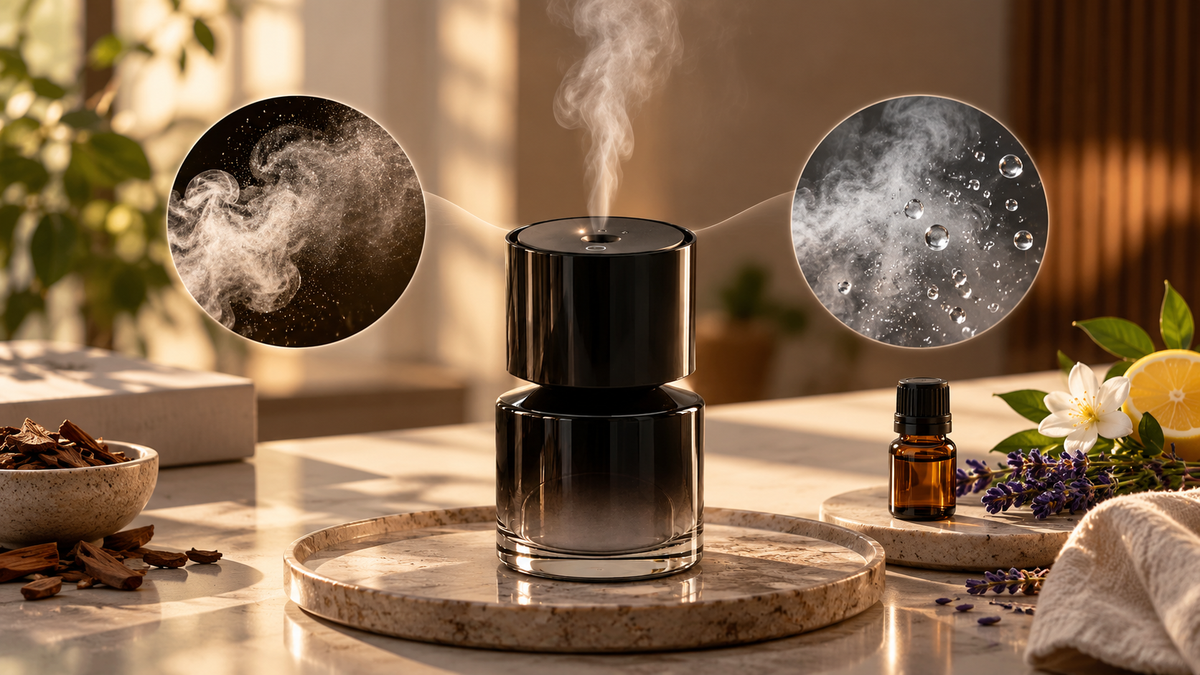
An ultrasonic diffuser has a water tank. You add water and a few drops of oil, and a small plate vibrates at high frequency, breaking the mixture into a cool mist. That mist carries the scent, and a little moisture, into the air.
The upside is that a few drops go a long way, and these units usually cost less upfront. The downside is dilution. The scent is softer, and standing water means regular cleaning, because a damp tank left alone is never a fun surprise.
How nebulizing (waterless) diffusers work
A nebulizing diffuser skips the water entirely. A small pump pushes air past a narrow tube dipped in oil. The fast-moving air pulls the oil up the tube and breaks it into very fine droplets, the same physics behind old-fashioned atomizer bottles. No water, no heat, just oil in the air.
Where a cordless waterless diffuser fits
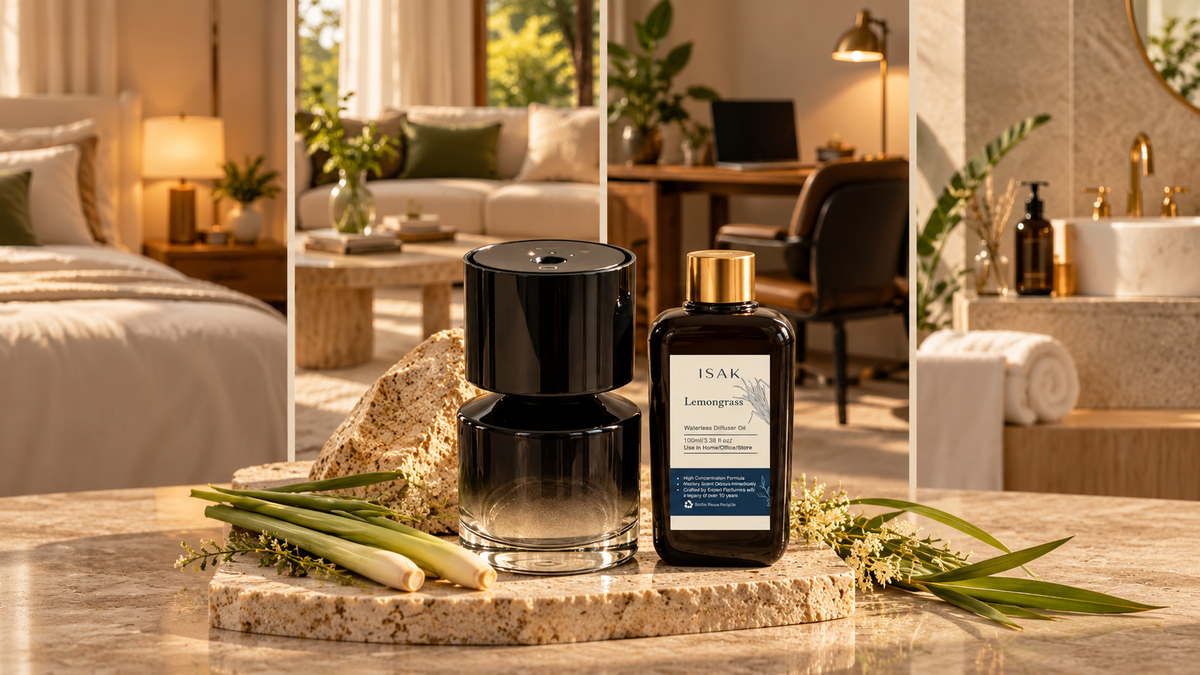
The Isak Cordless Aroma Diffuser is waterless and heatless, which puts it in the second family. The 100 ml oil bottle comes with a cap that houses the diffusion system, so there is no tank to refill and no dropper to count with. You screw it on and you are done.
It covers up to 20 sq m (about 215 sq ft), runs up to 24 hours on a charge, and charges over Type-C. It sprays in short bursts with pauses in between. Light mode (G1) sprays for 5 seconds and rests for 300, while strong mode (G2) rests for 180. A vehicle mode uses shorter bursts, and every session switches itself off after 3 hours.
Those pauses are smarter than they look. Your nose adapts to a constant smell within minutes, so bursts keep the scent noticeable without turning your living room into a perfume counter.
Why the oil matters more than the machine
In a waterless diffuser, the oil is the whole show. There is no water to soften it and no tank to forgive it. Three things follow.
Thickness. Heavy or resinous oils can block the fine passages, so use oil made for your device. Isak’s waterless diffuser oils are made to pair with its diffuser.
Quality. Undiluted scent shows off a flat or harsh formula very quickly. A good oil smells the same in the third hour as it did in the first minute.
The wrong stuff. Skip carrier oils, DIY blends, and alcohol-based perfume. None of them are designed to be atomized, and they can gum things up.
A few pairings to start with:
-
French Lavender for the bedroom, a classic pick for winding down
-
Lemongrass for a home office or balcony
-
Madurai Jasmine or Tuberose for a floral living room
-
Indian Rose for something soft and familiar
-
Vanilla for cosy evenings
-
Patchouli for earthy depth
If you would rather buy once, the diffuser also comes bundled with an oil, such as the Cordless Aroma Diffuser + French Lavender combo.
Which one should you pick?
Pick ultrasonic if you want a little humidity, the lowest oil spend, and do not mind rinsing a tank. Pick waterless if you want a stronger, cleaner scent, no water to manage, and a cordless diffuser that can travel from the balcony to the car. If you want no device at all, a reed diffuser works quietly, and a room freshener gives an instant burst.
Whichever you choose, run it in intervals rather than around the clock, keep the room ventilated, and set it on a stable surface where an occasional oil drip will not matter.
FAQs
What is a nebulizing diffuser?
It is a diffuser that uses air pressure to break undiluted oil into a fine mist, with no water or heat. It is also called a waterless diffuser.
Is a nebulizing diffuser better than an ultrasonic diffuser?
It depends on what you value. Nebulizing gives a stronger, undiluted scent with no water upkeep. Ultrasonic is gentler, adds a little humidity, and is usually cheaper to run.
Do waterless diffusers need water?
No. They atomize oil directly, so there is no tank to fill, no mineral buildup, and no standing water.
Can I use perfume or any essential oil in a waterless diffuser?
It is best not to. Use thin oils made for diffusers, and avoid carrier oils, thick blends, and alcohol-based perfume. Always check your manufacturer’s guidance.
How long does diffuser oil last in a nebulizing diffuser?
It depends on the setting, hours of use, and room size. Waterless models use oil faster than ultrasonic ones, so interval modes and auto-off timers help a bottle last longer.
How do I stop a nebulizing diffuser from clogging?
Use custom aroma oils made for it, avoid carrier oils, do not let old residue build up, and clean it as the manual advises.
Are waterless diffusers safe around pets and children?
Keep the room ventilated, avoid running it nonstop, and keep the device and oil out of reach. Some animals are sensitive to certain scents, so ask your vet before diffusing around pets.

Leave a comment
This site is protected by hCaptcha and the hCaptcha Privacy Policy and Terms of Service apply.