




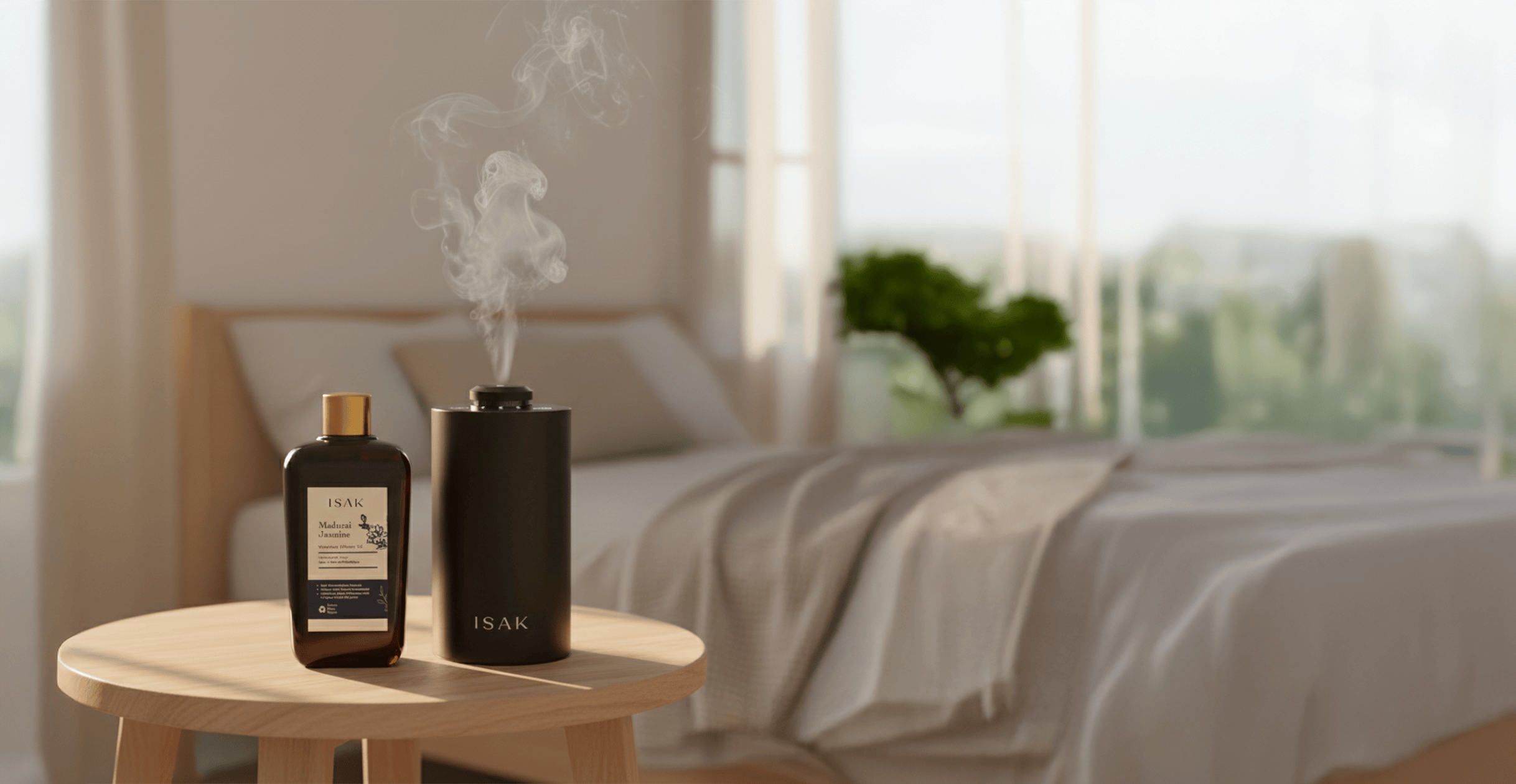
Reed Diffusers vs Diffuser Oils vs Air Fresheners: Which Home Fragrance Is Right for You?
Most people approach home fragrance the same way they approach perfume: they pick a scent they like and assume the product type does not matter much. In practice, the type of home fragrance you choose determines almost everything else: how the scent arrives in the room, how long it lasts, how much control you have over its intensity, and how much maintenance it demands. Reed diffusers, diffuser oils, and air fresheners each work through a different mechanism and serve a different kind of need. Choosing correctly means understanding those differences rather than defaulting to whichever product is easiest to find.
How Each Home Fragrance Type Actually Works
The three types are mechanically distinct, and that distinction shapes everything about the experience.
A reed diffuser works through capillary action. Porous wooden or rattan sticks are placed in a vessel containing fragrant oil. The oil travels upward through the internal structure of the reeds and evaporates from their exposed surface into the surrounding air. The process is entirely passive: no electricity, no flame, no manual activation. As long as there is oil in the vessel and the reeds are not clogged, the diffuser releases scent continuously.
A diffuser oil system, in its modern waterless or cordless form, works differently. Fragrance oil is added to a battery-powered or USB-powered device that uses a cold-air or heat-based nebulisation process to break the oil into fine particles and disperse them into the room. Unlike ultrasonic water-based humidifier diffusers, waterless diffusers do not dilute the oil with water, which means the scent output is more concentrated and the dispersion is faster and more controllable.
An air freshener in spray form delivers fragrance through direct manual application. You press the nozzle, the fragrance is released as a fine mist into the air or onto a surface, and the scent dissipates over the following minutes to hours depending on the formula and the concentration of aromatic material.
Understanding these mechanisms explains why the same fragrance can feel completely different across the three delivery types. The character of the scent itself matters, but so does how and how quickly it reaches your nose.
Reed Diffusers: Slow, Continuous, and Effortlessly Present

Reed diffusers are the right choice when what you want is a consistent ambient scent that operates in the background without requiring any attention. The passive release mechanism means the room never suddenly smells strongly of fragrance; instead, it maintains a low-level presence that builds gradually and feels like a natural quality of the space rather than something deliberately applied to it.
This subtlety is both the strength and the limitation of reed diffusers. In a small to medium room, a reed diffuser creates a genuinely pleasant ambient scent that visitors notice without being able to identify its specific source. In a large open-plan area, the same diffuser may not have enough scent output to make a meaningful impression because the fragrance disperses too widely before concentrating enough to be noticeable.
Placement significantly affects performance. Reed diffusers work best in areas with gentle air movement, near a doorway, on a windowsill with indirect airflow, or in an entryway where movement through the space carries the scent around. Placing a reed diffuser in a sealed, still room with no airflow reduces its effectiveness considerably.
The flip side of the passive mechanism is longevity. A well-constructed reed diffuser in a standard room will last several weeks to a few months on a single fill, which makes it one of the most cost-efficient home fragrance options over time. Flipping the reeds periodically, when the scent output feels reduced, refreshes the diffusion without adding more oil.
The three reed diffusers in the ISAK range are each built around a distinct scent character and presented in handmade, biodegradable clay bottles rather than glass, which makes them genuinely decorative objects as well as functional ones. The Moh-Ri-Ruh reed diffuser, which takes its name from an Urdu phrase meaning "My Soul," is centred on Indian Rose and suits bedrooms and living areas where a warm, grounding floral presence is the goal. The Rasa-Vada reed diffuser, named from a Sanskrit phrase meaning "Taste of Bliss in Absence of All Thoughts," uses lemongrass for a fresh, zesty character suited to workspaces, kitchens, or any room where an energising atmosphere is the priority. The Wabi-Sabi reed diffuser, drawing from the Japanese concept of wisdom in natural simplicity, uses lavender and suits bedrooms, meditation spaces, and anywhere calm is the intended atmosphere. All three are available with refills, which extends the life of the clay vessel indefinitely.
Diffuser Oils: Precise, Potent, and Mood-Specific

Waterless diffuser oils suit a different kind of user: someone who wants deliberate control over when their space is fragranced and how intensely, rather than a continuous passive background. The cordless or battery-powered dispersion mechanism means you can turn the scent on when you want it and off when you do not, which makes this the most controllable of the three options.
Because waterless diffusion does not dilute the oil, the scent output per millilitre of oil is higher than a reed diffuser or a spray can typically achieve. This also means the range of scent options available is broader, since different oils can be loaded into the same device depending on the mood or occasion. Madurai Jasmine for a meditative morning, Patchouli for a grounding evening, Vanilla for a warm and social atmosphere, Lemongrass for a fresh and focused workspace: the ISAK cordless diffuser oil range covers all of these, giving one device the flexibility of multiple fragrance personalities.
The tradeoff is the initial investment in the device and the need for charging or battery replacement. This is the right option for someone who already thinks about fragrance intentionally and wants a home scent that responds to their mood rather than running constantly in the background.
Air Fresheners: Immediate, Flexible, and Occasion-Ready

Air fresheners work differently from diffusers in one fundamental way: they are on-demand rather than ambient. You apply them when you need them, in the quantity you decide, in the specific area you choose. This makes them the most versatile of the three options and the most practical for a range of everyday situations that diffusers are not well-suited to handle.
The most obvious use case is odour neutralisation after cooking, after guests arrive in a closed room, or after any situation where a specific smell needs to be addressed immediately rather than gradually. A reed diffuser cannot respond to a sudden need. An air freshener can.
Air fresheners are also the right choice for targeted, room-specific fragrance use. You might want your bathroom to smell of something fresh and clean, your entryway to carry a welcoming scent when guests arrive, and your bedroom to be left unscented for sleeping. Spray air fresheners allow this kind of zoned, intentional application without committing to a scent that runs continuously in any one space.
The Forest Rain air freshener translates the petrichor, cedarwood, and musk character of the Forest Rain perfume into a room spray, making it one of the most distinctive options in this category and a natural complement to the perfume for anyone who wears it. The Lavender Rain air freshener suits bedrooms and bathrooms where a calming, clean impression is the priority. Citrus Burst, Fresh Waves, Green Woods, and Rose Wonder complete the range across fresh, woody, and floral directions, all starting from INR 390.
The tradeoff with air fresheners is that they require active use to maintain scent in a room. They do not build an ambient background the way a reed diffuser does; the scent fades within an hour or so of application and needs to be reapplied when needed. For anyone who wants home fragrance to require no thought or maintenance, a diffuser is a more suitable choice.
How to Choose the Right Home Fragrance for Your Space and Lifestyle
The decision is simpler than it might appear once you frame it around three practical questions.
The first is whether you want ambient or active fragrance. If you want your home to always carry a gentle background scent without any effort on your part, a reed diffuser is the right tool. If you want to choose when your space is fragranced and respond to specific situations on demand, an air freshener gives you that control. If you want deliberate, mood-specific fragrance with intensity control and the flexibility to switch scents, a diffuser oil system serves that need.
The second question is about room size and layout. Reed diffusers and diffuser oils are better suited to enclosed rooms where the fragrance can concentrate. Air fresheners work in any space regardless of size, since you control the quantity applied directly. In open-plan homes or large areas, an air freshener or a diffuser oil system will produce a stronger impression than a passive reed diffuser alone.
The third question is maintenance tolerance. Reed diffusers ask almost nothing of you beyond an occasional reed flip and an oil refill every few weeks. Diffuser oil systems need charging and an oil top-up. Air fresheners need to be actively used and repurchased regularly. The right choice is the one that fits the level of attention you are genuinely willing to give it.
Many homes benefit from all three: a reed diffuser in the living room or bedroom for constant ambient scent, a diffuser oil system for a home office or meditation corner where controlled intensity matters, and air fresheners in the kitchen and bathroom where on-demand use is more practical than a passive background.
Frequently Asked Questions
How long does a reed diffuser last compared to an air freshener?
A reed diffuser in a standard-size room typically lasts between four and twelve weeks depending on the volume of oil in the vessel, room temperature, and airflow. An air freshener spray lasts as long as the bottle contains product, but the scent itself dissipates from the air within one to two hours of application. Reed diffusers offer far longer continuous presence per unit of fragrance oil, making them more cost-efficient for ambient use over time.
Can I use diffuser oils in a reed diffuser vessel?
Not reliably, and it depends on the viscosity of the oil. Reed diffuser oils are specifically formulated to travel through reeds via capillary action, which requires a particular consistency. Waterless diffuser oils used in cordless electric devices are formulated differently and may not absorb into reeds effectively, producing little or no scent output. Using the right oil in the right delivery system gives far better results than mixing between them.
Which home fragrance type is best for a bedroom?
Reed diffusers are generally the most suitable for bedrooms because their passive, low-intensity release creates a gentle ambient scent without requiring any action at bedtime. Lavender-forward options like the Wabi-Sabi reed diffuser are particularly well-suited since lavender has well-documented calming properties and works with the sleep environment rather than against it. Air fresheners applied shortly before bed can also work, but the initial intensity of a spray is not always ideal for a sleeping environment.
Are air freshener sprays safe to use around children and pets?
Most commercially formulated air fresheners, including those meeting IFRA safety standards, are safe for use in homes with children and pets when used as directed, meaning in ventilated spaces without direct application near faces or food. Allowing the mist to settle before children or pets re-enter the room reduces exposure to the concentrated spray. If you have concerns about specific sensitivities, checking the ingredient list for known allergens is always a good precaution regardless of product type.
How do I make a reed diffuser smell stronger?
Adding more reeds increases the surface area from which oil evaporates and produces a stronger scent output. Flipping the reeds so the saturated ends face upward temporarily boosts intensity. Placing the diffuser in an area with more airflow also increases dispersion. The tradeoff is that more reeds and higher airflow also deplete the oil faster, reducing the overall lifespan of each fill. In smaller rooms, fewer reeds and a sheltered position often produce a more balanced and longer-lasting result than loading the maximum number of reeds from the start.



Leave a comment
This site is protected by hCaptcha and the hCaptcha Privacy Policy and Terms of Service apply.