


How Long Should a Home Fragrance Actually Last? What Affects Scent Longevity in a Room
If you have ever sprayed a room freshener, enjoyed it for twenty minutes, and then wondered where it went, you are not alone. The most common complaint about home fragrance products is that they do not last long enough. Most of the time, the product is not the problem. Once you understand how fragrance actually behaves in a room, you can get dramatically more out of whatever you are already using.
Why Home Fragrance Seems to Disappear So Quickly
Before blaming the product, it is worth understanding the difference between fragrance actually fading and fragrance you can no longer detect. These are two different things.
Olfactory adaptation, or nose blindness, is the process by which your brain stops registering a scent after 15 to 20 minutes of continuous exposure. It is a survival mechanism: your olfactory system filters out background stimuli to prioritise new information. A room freshener you sprayed 30 minutes ago may still be fully present and detectable to anyone walking in fresh, while being completely invisible to you.
The correct test is not whether you can still smell it after sitting in the room. It is whether you can detect it when you re-enter after stepping out for a few minutes. If yes, the product is working.
The Five Main Factors That Affect Longevity
Room size and ventilation is the most significant variable. A freshener that fills a bathroom beautifully will seem to disappear in a large open-plan living area because the same fragrance molecules are distributed across a much greater volume of air. Open windows, ceiling fans, and air conditioning all accelerate dispersal. Smaller, more enclosed rooms benefit most from a single application.
Temperature and humidity matter significantly in the Indian context. Heat accelerates evaporation, which is why a product that performs well in October feels short-lived in May. High humidity during monsoon causes fragrance to diffuse more broadly and fade faster. The most fragrance-friendly conditions are moderate temperature with low air movement, broadly the Indian winter months from October to February.
Surface type is the single most actionable variable. Fragrance sprayed into open air disperses and disappears within 20 to 45 minutes in a normally ventilated Indian room. The same spray on a curtain can still be detectable six to eight hours later. Fabric fibres absorb aromatic molecules and release them slowly as the fabric interacts with warmth and air movement. Hard surfaces like tiles and walls fall in between. Most people spray into air by habit, which is the least effective approach for longevity.
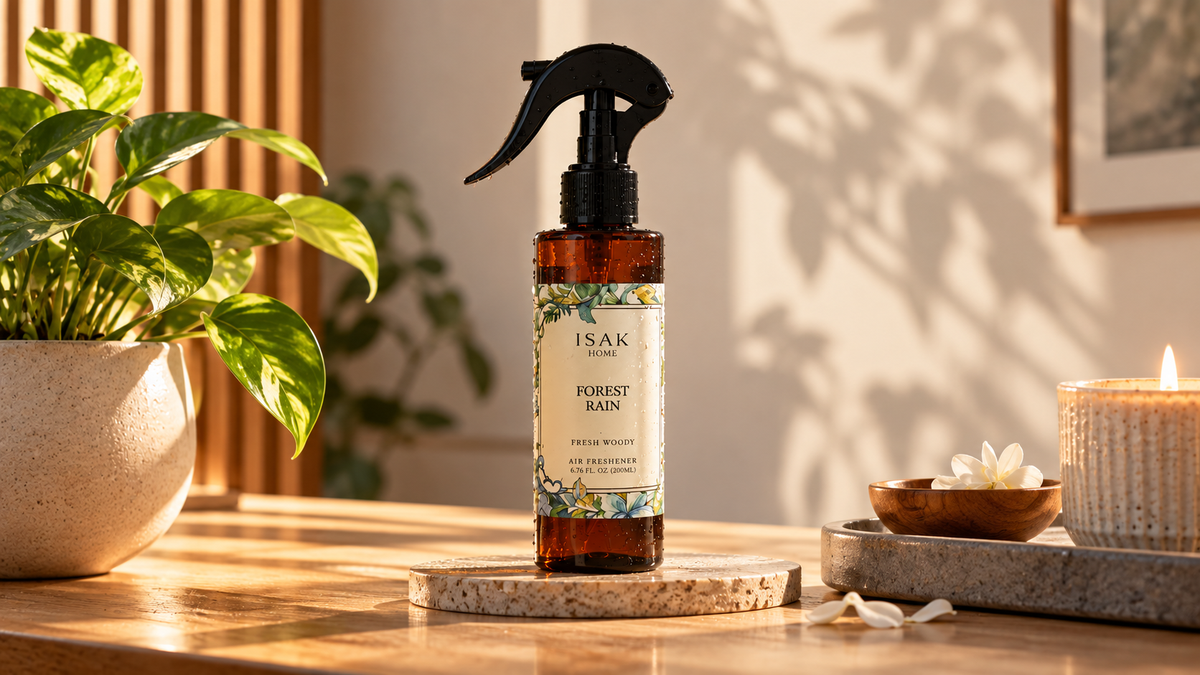
Formula concentration and quality determine how much aromatic material is actually present per spray. Mass-market fresheners dilute heavily, producing a dramatic opening that fades quickly. Better formulas include base-note materials like cedarwood, sandalwood, amber, and musk that have the molecular weight to bind to surfaces and release slowly. The Forest Rain air freshener is a clear example: its musk and cedarwood base continues releasing off fabric long after the lemon and lilac top notes have faded. IFRA-compliant formulas also tend to be more consistently constructed, making them better performers beyond just the safety assurance.
Application method determines longevity as much as product quality. Two to three sprays on a large curtain from 30 centimetres away will outperform ten sprays into open air in terms of all-day presence and use significantly less product doing it. Apply in the morning rather than immediately before you want to smell the fragrance: the scent that binds to fabric in the morning is still active by evening.
Realistic Longevity by Product Type
A spray air freshener applied to open air in a normally ventilated Indian room lasts 20 to 60 minutes. The same spray on curtains lasts four to eight hours, longer on heavier fabrics. In a small, enclosed room with no active airflow, air longevity extends to around two hours.
The Lavender Rain air freshener applied to bedroom curtains in the evening will typically still be detectable the following morning thanks to its sandalwood and amber base. The Citrus Burst air freshener fades faster on fabric because citrus molecules are inherently more volatile, but still meaningfully outlasts air-only application. The Rose Wonder air freshener has among the best fabric longevity in the range because rose's heavier aromatic compounds bind to fibres more effectively than citrus or aquatic formulas.
Reed diffusers like Moh-Ri-Ruh and Wabi-Sabi provide continuous passive fragrance for four to twelve weeks per fill. The tradeoff is that they build gradually rather than arriving immediately. For rooms where you want an always-on ambient scent without management, they are the right tool. For on-demand impact, a spray freshener delivers what a diffuser cannot.
How to Make Home Fragrance Last Longer
Redirect application from air to fabric. This one change extends longevity more than any product upgrade. Combine a reed diffuser as a constant background with a spray freshener for moments of impact: they work together rather than competing. Allow the freshener 10 to 15 minutes to settle onto surfaces before opening windows or turning on fans. Closed rooms hold fragrance significantly better than ventilated ones, so in larger open-plan spaces always prioritise fabric over air application.
Frequently Asked Questions
Why does my room freshener seem to disappear after 20 minutes?
Your nose has most likely adapted to it: step out of the room and come back, and you will probably smell it again.
Does a more expensive room freshener last longer?
Not automatically, but formulas with higher aromatic concentration and base-note materials like cedarwood and musk consistently outperform cheaper, more diluted alternatives.
How does Indian humidity affect room freshener longevity?
High monsoon humidity causes fragrance to diffuse more broadly and fade faster; dry air-conditioned environments reduce the slow-release effect of fabric application; Indian winter produces the most consistent longevity.
How often should I reapply for continuous scent?
Once in the morning on curtains and soft furnishings is sufficient for all-day fabric presence; for open-air application only, every one to two hours is realistic.
Are reed diffusers or air fresheners better for longevity?
Reed diffusers provide continuous low-intensity fragrance lasting weeks; air fresheners provide immediate on-demand impact requiring regular reapplication: the most effective approach is using both together.
Why does the same freshener last longer in my bedroom than my kitchen?
Bedrooms are smaller, cooler, more enclosed, and have more fabric surfaces; kitchens are warmer, better ventilated, tile-heavy, and compete with cooking odours.
What is the best way to apply a room freshener for maximum longevity?
Spray lightly onto curtains and cushions from 30 centimetres away rather than into the air: fabric holds fragrance several hours longer than open air.
Does room freshener longevity change across Indian seasons?
Yes: Indian summer heat shortens longevity significantly, monsoon humidity creates broad diffusion that fades quickly, and winter conditions produce the longest-lasting performance from any home fragrance product.

Leave a comment
This site is protected by hCaptcha and the hCaptcha Privacy Policy and Terms of Service apply.