


Oud Attar vs Oud Perfume: Which Should You Actually Choose?
If you have spent any time exploring oud fragrances, you have almost certainly hit this question. You find a scent you love in an oud composition, notice it comes in both an attar and a perfume, and then spend ten minutes wondering what the actual difference is and which one you should buy. The easy answer is that one is oil-based and one is alcohol-based. But that single distinction creates a cascade of differences in how the fragrance smells, how it develops on skin, how long it lasts, how it projects, and which occasions it genuinely suits. Understanding those differences does not require a chemistry degree. It just requires knowing a few things about how oud works and how these two delivery systems interact with it differently.
What Makes Oud Worth Understanding in the First Place
Before comparing the two product types, it helps to understand what oud actually is, because the material itself influences how it behaves differently across each delivery system.
Oud, also known as agarwood or oudh, is a resinous heartwood that forms inside trees of the Aquilaria genus, particularly Aquilaria malaccensis, when they become infected by certain fungal organisms. In response to this infection, the tree produces a dense, dark, aromatic resin as a defence mechanism. This resin-saturated wood is what we call agarwood, and the oil extracted from it through distillation is oud oil.
The process is rare and slow. Only a small percentage of wild Aquilaria trees develop this resin naturally, and the infected wood must mature over years before it develops the full complexity of aroma that makes oud valuable. This scarcity is why real oud oil is among the most expensive natural fragrance materials in the world, with high-quality wild oud oil commanding extraordinary prices per gram on international markets.
The scent of oud is genuinely complex and not always easy to describe on first encounter. At its core it is woody and warm, but depending on the origin of the tree, the extraction method, and the age of the oil, it can carry notes that are simultaneously sweet, smoky, animalic, leathery, earthy, or even slightly medicinal. Indian oud from Assam, which has a long history in the subcontinent's perfumery tradition, tends toward deeper, more animalic and earthy character. This regional nuance matters when evaluating how oud behaves in both attar and perfume compositions.
What an Oud Attar Actually Is
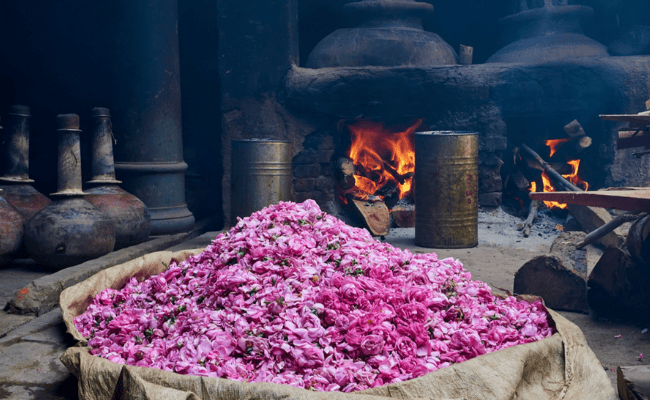
An attar is a perfume oil: 100% aromatic material with no alcohol content whatsoever. Traditional Indian attars have a heritage stretching back centuries, predating the adoption of alcohol as a fragrance carrier in the Western perfumery tradition. In the classical attar-making process using the Deg and Bhapka hydro-distillation method, botanical materials are steam-distilled directly into a sandalwood oil receiver, so the resulting attar carries the aromatic character of both the distilled ingredient and the sandalwood base.
Modern attars may use different carrier oils or refined aromatic concentrates, but the defining characteristic remains: pure oil, no alcohol, highly concentrated aromatic material applied directly to the skin.
Because there is no alcohol to volatilise the fragrance outward on application, an attar behaves differently on skin from the first moment. Rather than the dramatic initial burst of an alcohol-based spray that diffuses the scent into the surrounding air, an attar warms slowly with your body temperature and releases its aromatic character in a gradual, intimate way. The projection stays close to the skin. This is not a flaw; it is the defining quality of attar wear. The fragrance belongs to you and those close to you rather than announcing itself across a room.
A small quantity of attar goes a very long way. One to three drops applied to pulse points, or a light roll-on application to the inner wrists and base of the throat, is typically sufficient for a full day of wear. Because oil does not evaporate at the rate that alcohol does, the aromatic material stays on skin and continues releasing across many hours, often six to ten or more depending on the composition and the wearer's skin type.
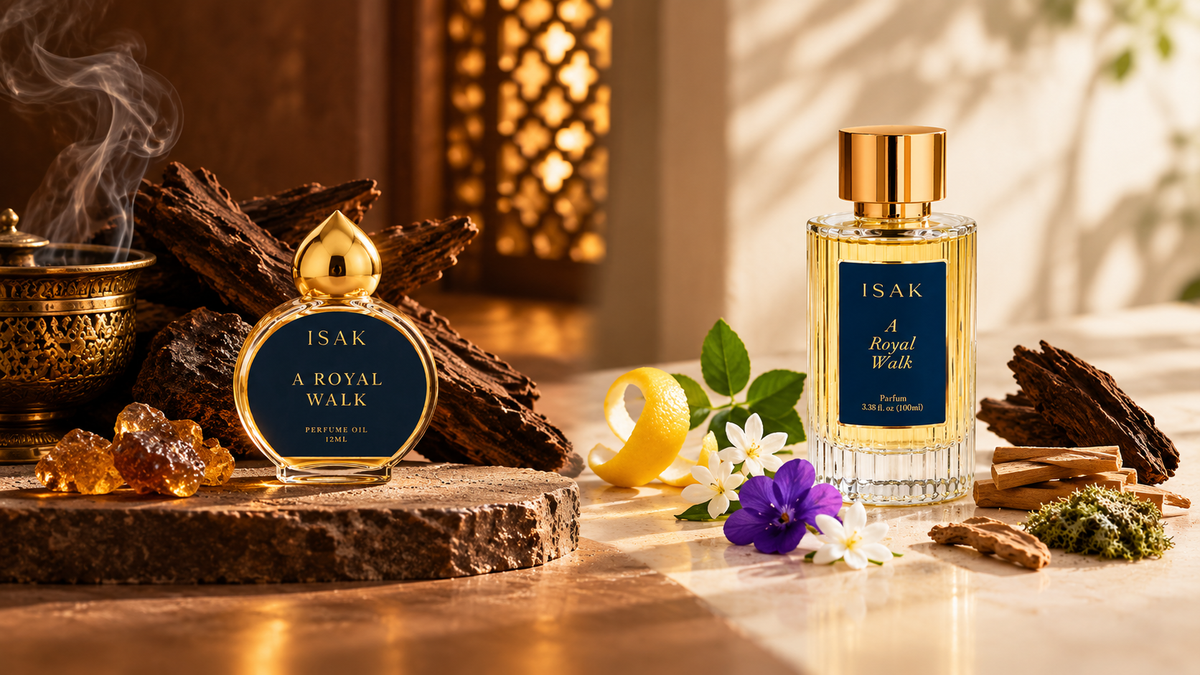
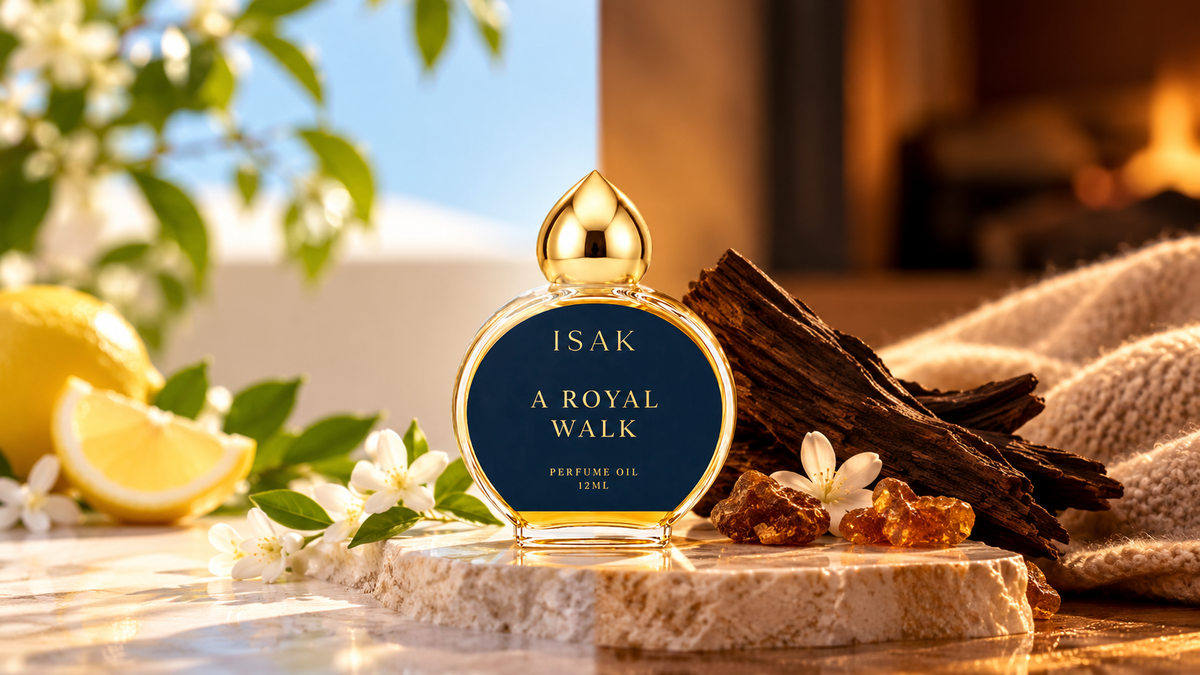
The A Royal Walk Attar is a clear example of how well oud works in this delivery system. It opens with lemon and galbanum, a green and slightly herbal top note that gives an immediate freshness before the oil warms and the character shifts. Then orris root rises, one of the most expensive and patient materials in perfumery, powdery and cool, followed by violet and jasmine in the heart. The oud, sandalwood, musk, and oakmoss base is where the attar truly settles: deep, grounded, and quietly authoritative. Because it is 100% oil, this dry-down is what you wear for most of the day. The progression is slower and more linear than an EDP, which is exactly what attar wear is meant to be.
What an Oud Perfume Actually Is
An oud perfume in EDP concentration dissolves aromatic materials in ethanol, typically achieving a concentration of around 15 to 20 percent aromatic concentrate in the finished product. The alcohol is not just a diluent; it is an active part of how the fragrance works.
When you spray an EDP onto skin, the alcohol evaporates rapidly. This evaporation is what carries the fragrance molecules outward into the surrounding air, creating the initial projection and the sillage that people nearby can detect. The top notes, which are the most volatile aromatic materials, are what you smell in the first five to thirty minutes. They are designed to make an immediate impression. As the alcohol evaporates fully and the top notes fade, the heart notes emerge, and finally the base notes, which have the heaviest molecular weight and the longest staying power.
This top-to-heart-to-base progression is the note pyramid structure that every EDP is built around, and it means the fragrance you smell at the point of spraying is genuinely different from the fragrance you smell two hours later. For oud-based EDPs, this is particularly significant because oud sits in the base layer: the part that takes time to fully reveal itself but also the part that lasts longest and creates the most distinctive impression.
At 20 percent concentrate, an EDP formulated with quality aromatic materials is significantly longer-lasting than lighter concentrations and projects more broadly. The higher the aromatic concentration, the more the fragrance can project into the space around you beyond just skin contact.
The A Royal Walk Perfume carries the identical note composition to the attar: lemon and galbanum on top, violet, jasmine, and orris in the heart, with oud, sandalwood, musk, and oakmoss at the base. But the experience of wearing it is genuinely different. The alcohol delivery means the lemon and galbanum opening is more vivid and more present in the room on first application. The orris and jasmine heart has a clarity and projection in the EDP that the attar, with its oil-slowed development, approaches more quietly. And the oud and oakmoss base, while carrying the same aromatic character, creates a broader sillage in EDP form: the trail you leave when you walk through a room, the scent that lingers after you have already moved on.
How the Two Compare Across What Actually Matters
The same oud composition in attar and EDP forms gives you a useful direct comparison because the note structure is identical and only the delivery system differs.
Concentration: The attar is 100% perfume oil with no alcohol. The EDP is 20% aromatic concentrate in alcohol. This does not mean the EDP is weaker; it means the aromatic material is present in different proportions and reaches your nose through a different mechanism.
Projection and sillage: The attar projects intimately, staying close to the skin and detectable primarily to you and anyone within arm's reach. The EDP projects into the room, creating a broader sillage that others can detect at greater distance. Neither is better in absolute terms; the right choice depends on the impression you want to make and the context you are in.
Longevity: Both are long-lasting, but for different reasons. The attar lasts because oil binds to skin and releases slowly over many hours without requiring evaporation to diffuse. The EDP lasts because the 20 percent aromatic concentrate, particularly its heavy base notes, continues releasing from skin and fabric long after the alcohol has evaporated. In practice, both can achieve six to eight hours of perceptible wear on well-moisturised skin, but the attar's longevity is more consistent across different environments because it is not affected by humidity or temperature in the same way an alcohol-based product is.
Alcohol content: The attar contains none. This is the most practically significant distinction for a meaningful portion of Indian fragrance buyers who avoid alcohol-based products for personal or religious reasons. If this applies to you, the attar is not a compromise option; it is the product that was specifically designed for how you want to wear fragrance.
Application: The attar is applied by dabbing or rolling a small quantity directly onto pulse points. The EDP is applied via spray, which gives more even distribution across a larger surface area. Spray application is faster and more intuitive for most people accustomed to contemporary fragrances.
Price per wear: At INR 1,190 for 12ml of 100% oil versus INR 3,600 for 100ml at 20% concentrate, the per-wear cost calculation is less straightforward than it might look. A single application of attar uses roughly 2 to 4 drops (less than 0.2ml), meaning a 12ml bottle contains 60 to 90 applications. The EDP at 2 to 3 sprays per application from a 100ml bottle gives you significantly more applications by volume but at a higher absolute price. For regular daily wear, the EDP offers better value per application at scale. For someone who uses oud occasionally and wants the experience to feel deliberate and considered, the attar's small-quantity ritual has its own kind of value.
Occasion suitability: The attar suits intimate settings, formal occasions where you want presence without projection, and any context where close-to-skin wear is preferable. The EDP suits occasions where you genuinely want to make a broader impression: a formal dinner, a wedding, a professional setting where a confident sillage is part of the statement you want to make.
How to Actually Make the Decision
The decision between an oud attar and an oud perfume is not really about which is superior. They serve genuinely different purposes, and the best answer is often to own both rather than treating it as an either/or choice.
If you are new to oud and want to understand what the fragrance character is before investing in the full EDP, the Crimson Oud Attar at INR 390 for 3ml is an exceptionally low-cost entry point. Wear it across several occasions to understand how the oud, sandalwood, and oakmoss base feels on your skin, how the orris and violet heart suits your personality, and whether the intimate projection of oil wear is something you enjoy or find insufficient for your purposes.
If you know you want broad projection for formal occasions and high-impact wear, the EDP is the right tool. The Crimson Oud Perfume at INR 2950 is a long-term investment in a fragrance that will be present and memorable across the occasions that call for it.
If you avoid alcohol-based products, the attar is not a second choice. It is the appropriate product for how you want to engage with fragrance, and it delivers the full character of the oud, sandalwood, and oakmoss composition in the form that Indian perfumery developed specifically for that purpose.
Frequently Asked Questions
Does oud attar last longer than oud perfume?
Both are long-lasting, but for different reasons. An oud attar in 100% oil binds to skin and releases slowly over six to ten hours without needing evaporation to work. An oud EDP at 20% concentrate lasts through the staying power of its heavy base notes, particularly oud, sandalwood, and musk, which continue releasing from skin after the alcohol has fully evaporated. In warm, humid Indian conditions, the attar may have a slight edge in consistency because humidity does not affect oil diffusion the way it can affect alcohol-based projection.
Can I wear oud attar and oud perfume together?
Yes, and this is a layering technique experienced fragrance wearers use intentionally. Applying the attar to pulse points first creates an oil base that anchors the aromatic character close to the skin. Then spraying the EDP over and around it adds the projection layer on top. Because both the A Royal Walk Attar and the A Royal Walk Perfume share the same note composition, layering them produces a more complex and longer-lasting version of the same fragrance rather than a clash between competing profiles.
Is oud attar suitable for daily wear or is it too heavy?
Oud attar is intimate in projection, which actually makes it more suitable for daily wear than many people expect. The close-to-skin wear means it is present to you without projecting heavily into shared spaces, which makes it considerate for office and public environments where strong fragrances can be intrusive. One to two drops is sufficient for daily wear, and the oil concentration means you are unlikely to over-apply in the way that spray fragrances sometimes encourage.
Why does real oud smell different from most commercial oud fragrances?
Most mass-market fragrances that claim oud as a note use synthetic oud molecules or oud accords rather than real agarwood oil. These synthetic alternatives are consistent and cost-effective, but they capture only a fraction of the complexity of real oud oil, which contains hundreds of individual aromatic compounds that interact with skin and air in ways a single synthetic molecule cannot replicate. Real oud-based compositions, particularly attars made through traditional distillation methods, develop and shift on skin over time in a way that synthetic alternatives tend not to. If a fragrance marketed as oud smells uniformly sweet and woody from application to dry-down without variation, it is likely built around a synthetic accord rather than real agarwood oil.
Is oud attar alcohol-free and why does that matter?
Yes, attar is 100% perfume oil with no alcohol content. This matters for several reasons. For those who avoid alcohol-based products for religious reasons, attar is not a compromise; it is the traditional and historically appropriate fragrance form. For those with sensitive skin, alcohol-free oil can be gentler on application, particularly for people who experience dryness or irritation from repeated alcohol contact. And for fragrance purists, oil-based delivery produces a different and some would argue more intimate experience of the aromatic character because there is no alcohol volatilisation altering the initial impression of the scent.
How should I apply oud attar correctly?
Apply one to three drops to warm pulse points: the inner wrists, the base of the throat, and behind the ears. Do not rub the wrists together after applying; allow the oil to warm naturally with your body temperature. The fragrance will develop and deepen over the first 30 to 60 minutes as the oil warms, and it will stay present throughout the day from these points. For formal occasions where you want slightly more presence, adding a drop to the inner elbow or the collarbone extends the aromatic reach without significantly changing the intimate character of attar wear.

Leave a comment
This site is protected by hCaptcha and the hCaptcha Privacy Policy and Terms of Service apply.